
AI Adoption Roadmap for a Product Team
Overview
I led an AI adoption initiative within Scrum Alliance’s Product Team, facilitating opportunity discovery, developing a phased implementation roadmap, and improving team workflows. One early application reduced course development timelines from 6–8 months to 3–4 months.
Responsibilities: Initiative Lead, team-level AI adoption, roadmap development, and workflow optimization
Tools Used: Miro, Google Gemini, surveys, AI prompting tools, Slack
Skills: 5–10 Product Team members
Portfolio note: Artifacts in this case study have been recreated and, in some cases, enhanced for portfolio purposes. Original internal materials are not shared to protect proprietary information. These examples illustrate my approach and design thinking; they may differ from the original project materials.

The Challenge
The Product Team had not previously integrated AI into its content development or broader workflows. The team needed a structured way to identify opportunities, determine where AI could add value, coordinate experimentation, and evaluate its impact on team effectiveness.
The Solution
I facilitated a collaborative workshop to identify AI opportunities across the Product Team, translated those opportunities into a phased adoption roadmap, and partnered with team members to pilot workflow improvements. I also established baseline metrics and created a shared prompt playbook to support evaluation, knowledge-sharing, and ongoing adoption.
Strategy and Execution
Designed and Facilitated Collaborative Discovery
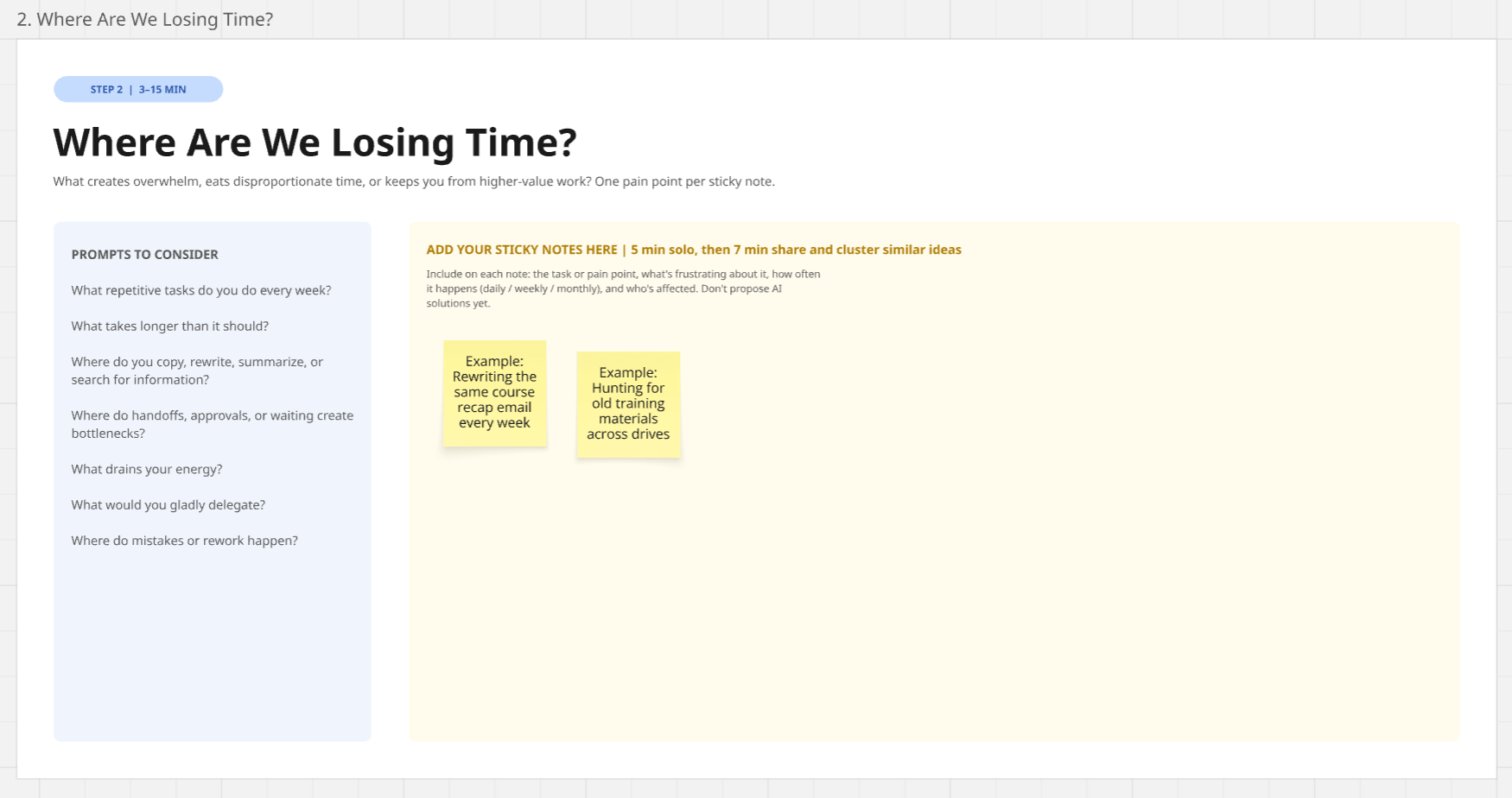
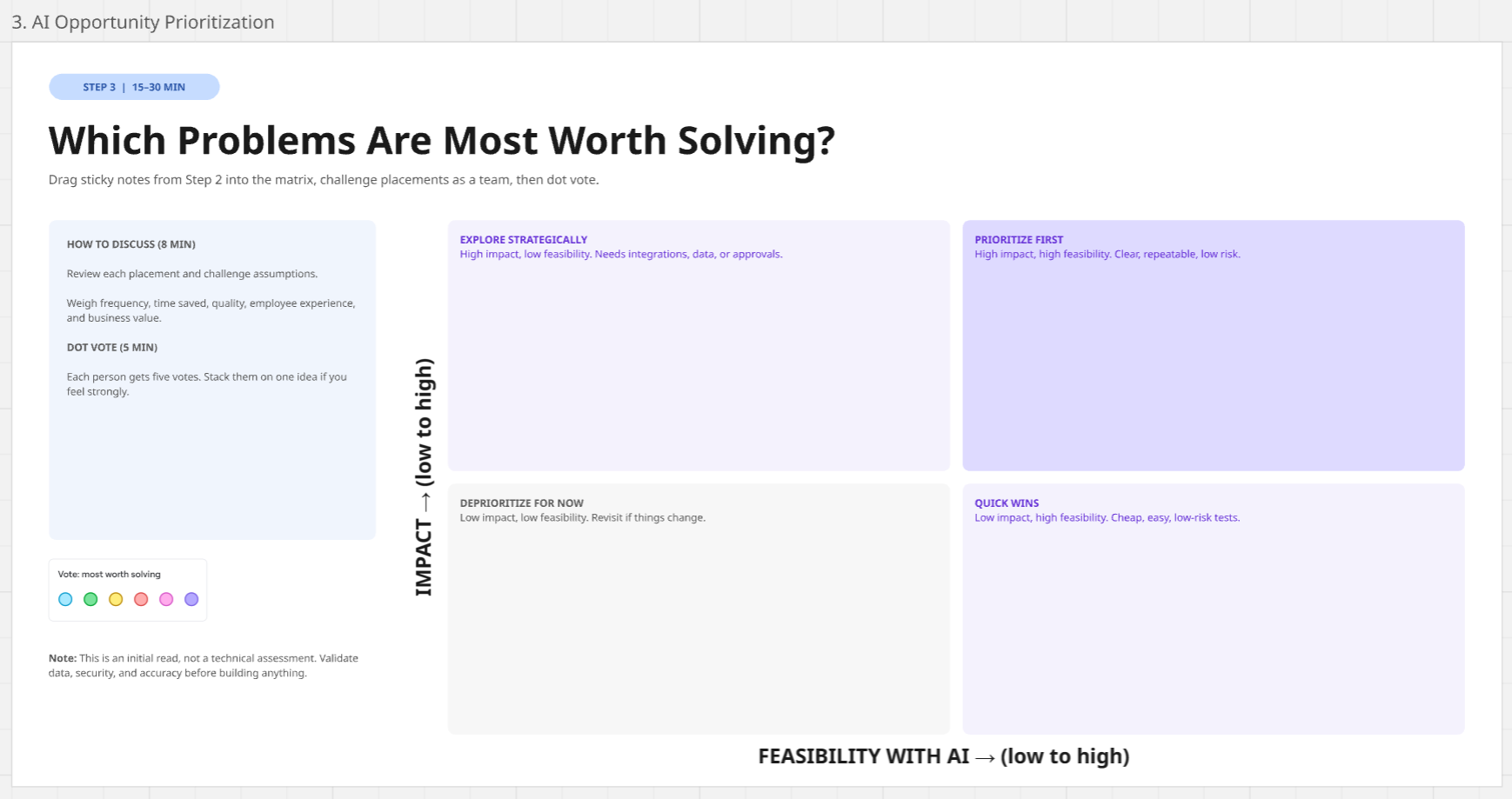
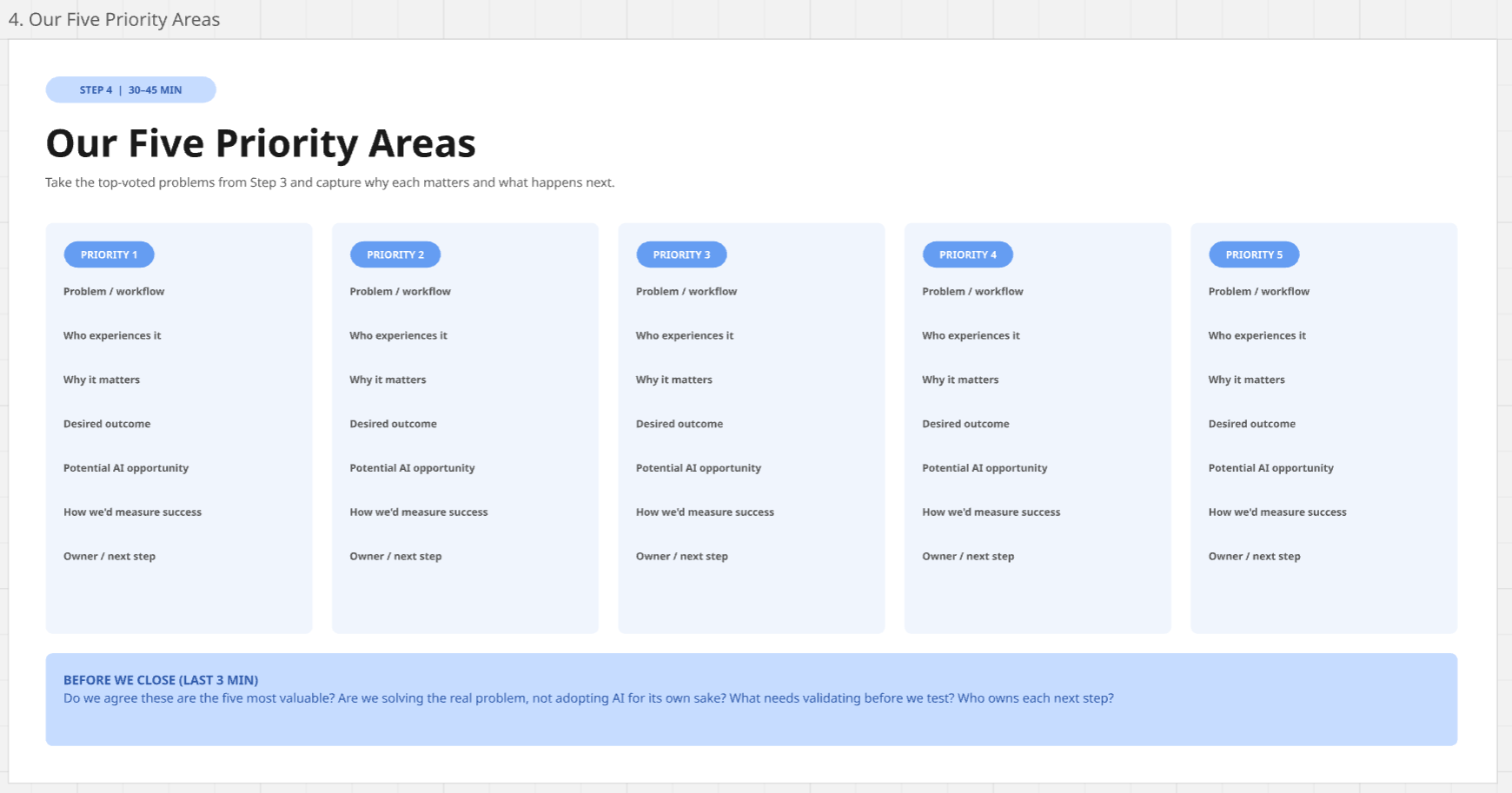
First, I designed and led a workshop in Miro with a team of 5–10 people to identify five areas where we wanted to explore AI implementation.
The workshop provided a collaborative environment for surfacing workflow challenges, identifying opportunities, and establishing shared priorities. This helped ensure the roadmap reflected the team's actual work and needs.
Translated Opportunities into a Strategic Roadmap
I used Google Gemini to help structure and draft a phased AI adoption roadmap based on the team's workshop findings, refining the plan around our priorities and implementation needs.
I organized the five focus areas into a year-long rollout, with team members serving as domain experts for their respective workstreams. The roadmap provided a shared direction for implementation while distributing responsibility across the team.
AI Strategic Roadmap Features:
Executive Summary: Outlines the business challenge, strategic objectives, and intended outcomes of an AI adoption initiative.
Five Strategic Focus Areas: Covers AI governance and readiness, content development, feedback management, SME management and knowledge capture, and workflow integration and value realization.
Phased Rollout Timeline: Maps five implementation phases across a 12-month period, with milestones, dependencies, and decision gates.
Domain Ownership: Identifies accountable team member domain experts and supporting stakeholders for each phase.
KPI & Gap Analysis: Connects operational challenges to baseline metrics, measurable targets, and desired outcomes.
Baseline Measurement Plan: Defines the operational data, workflow observations, and employee feedback needed to assess current performance.
Employee Survey Questions: Includes sample questions to identify AI skill gaps, workflow bottlenecks, adoption barriers, and opportunities for improvement.
Success Metrics & Evaluation Criteria: Tracks efficiency, content quality, feedback processing, SME review turnaround, adoption, and business value.
Learnings
Improvements I would make to the strategic roadmap
Responsible AI Governance: Incorporates risk reviews, approved-use guidelines, human oversight, and quality safeguards.
Evidence-Based Decision Gates: Establishes criteria for scaling, refining, pausing, or discontinuing AI initiatives based on measured outcomes.
Established a Measurement Approach
I created baseline surveys to establish a starting point for evaluating the initiative's effects on both operational efficiency and team experience.
The surveys focused on four dimensions:
Team satisfaction: How team members experienced their work and evolving workflows.
Workload and overwhelm: Where capacity constraints and friction existed.
Trust in AI: How comfortable team members felt using AI to support their work.
Time spent on tasks: A baseline for assessing potential efficiency improvements.
This approach was intended to move evaluation beyond tool usage alone and consider whether AI was meaningfully improving how the team worked.
Playbook Creation to Support Adoption and Knowledge Sharing
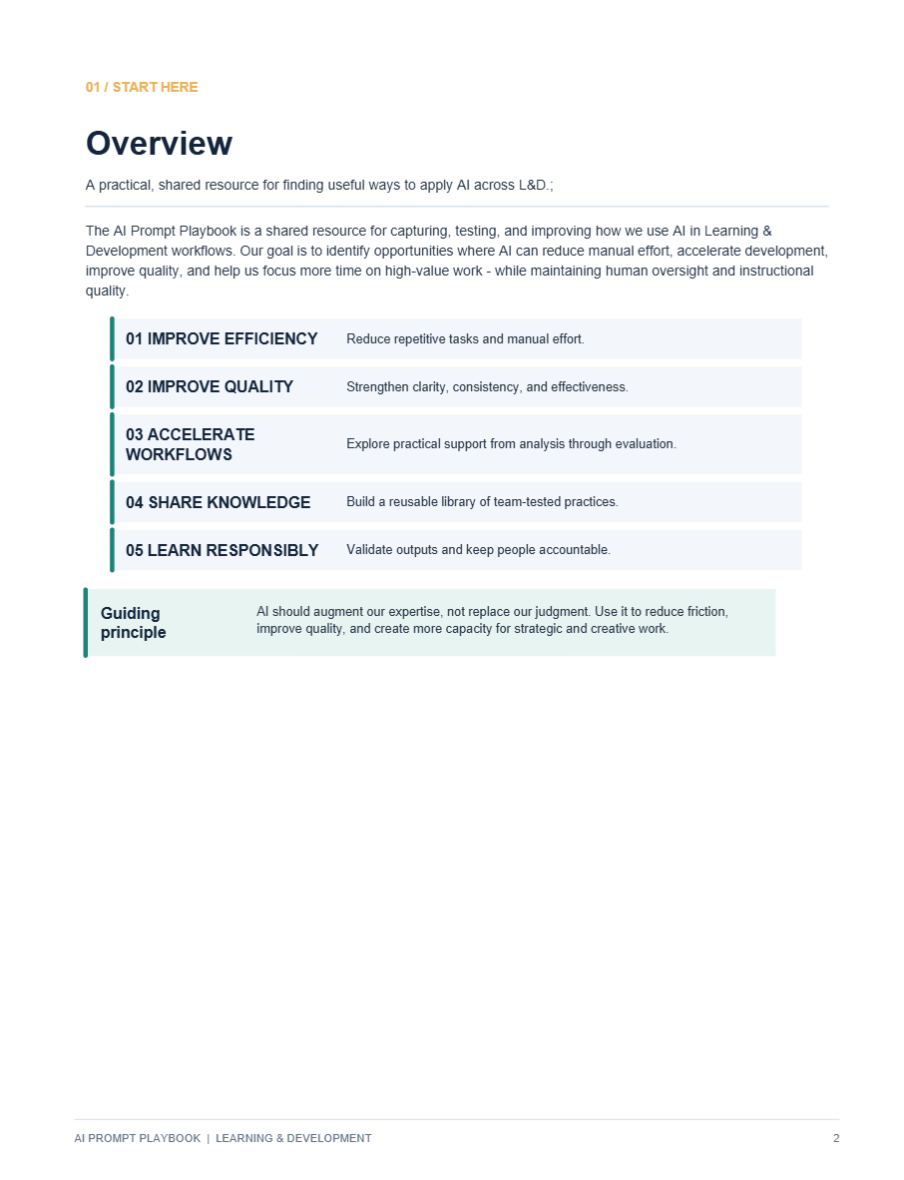
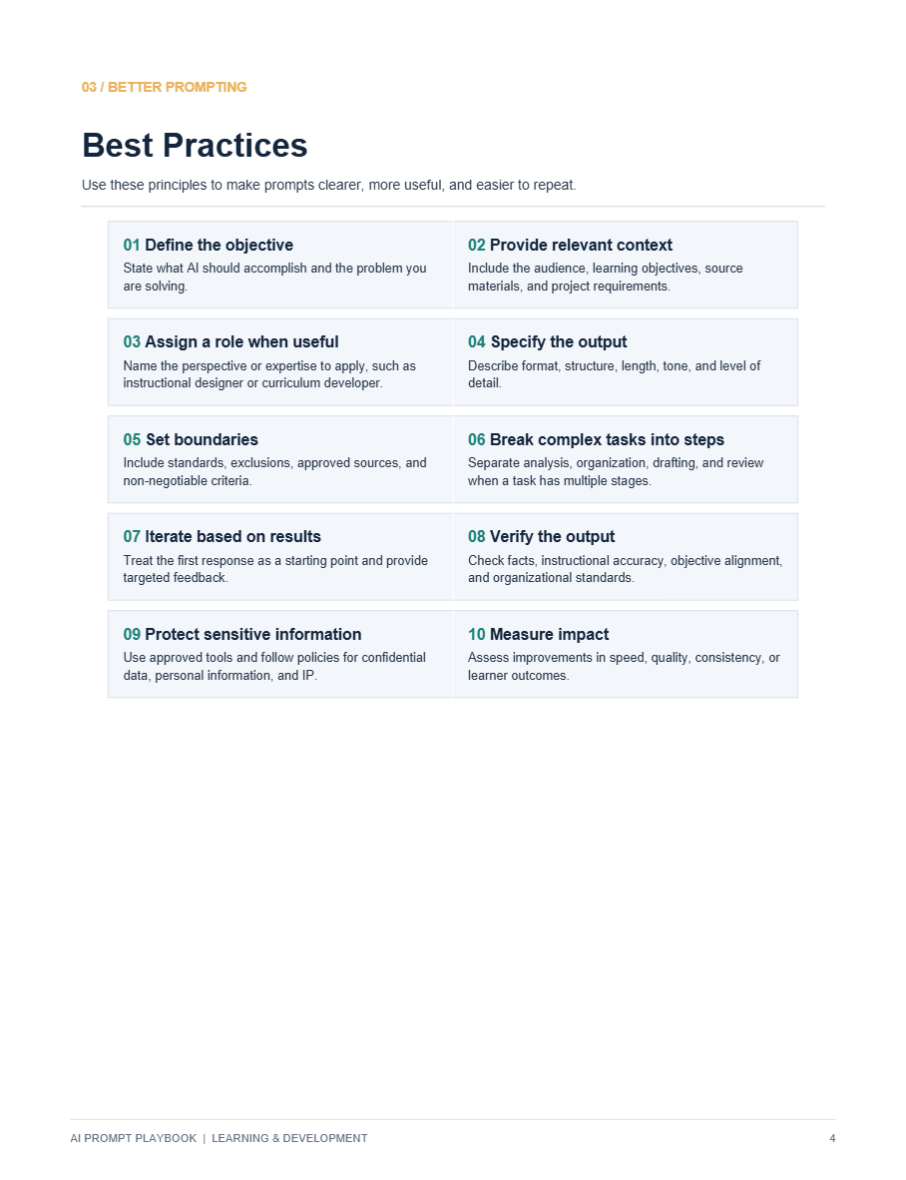
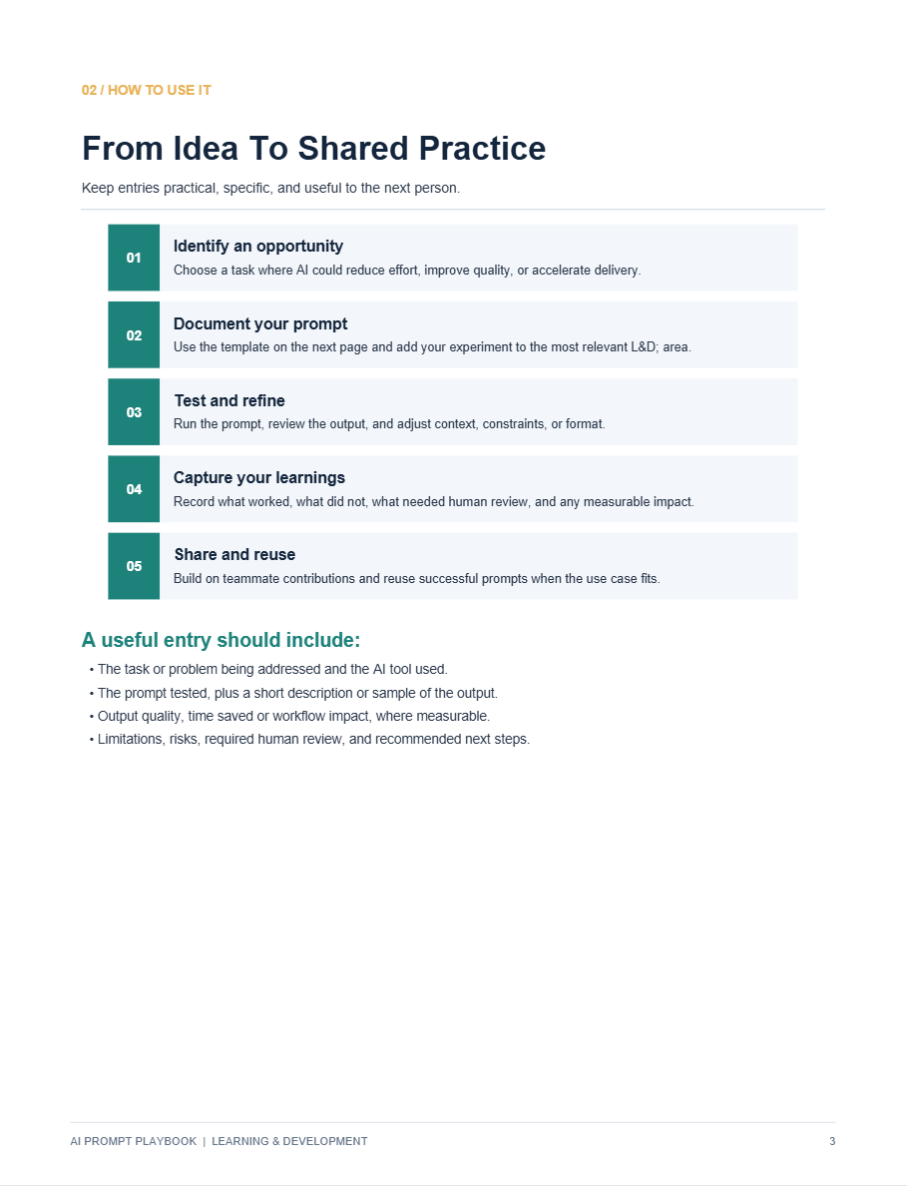
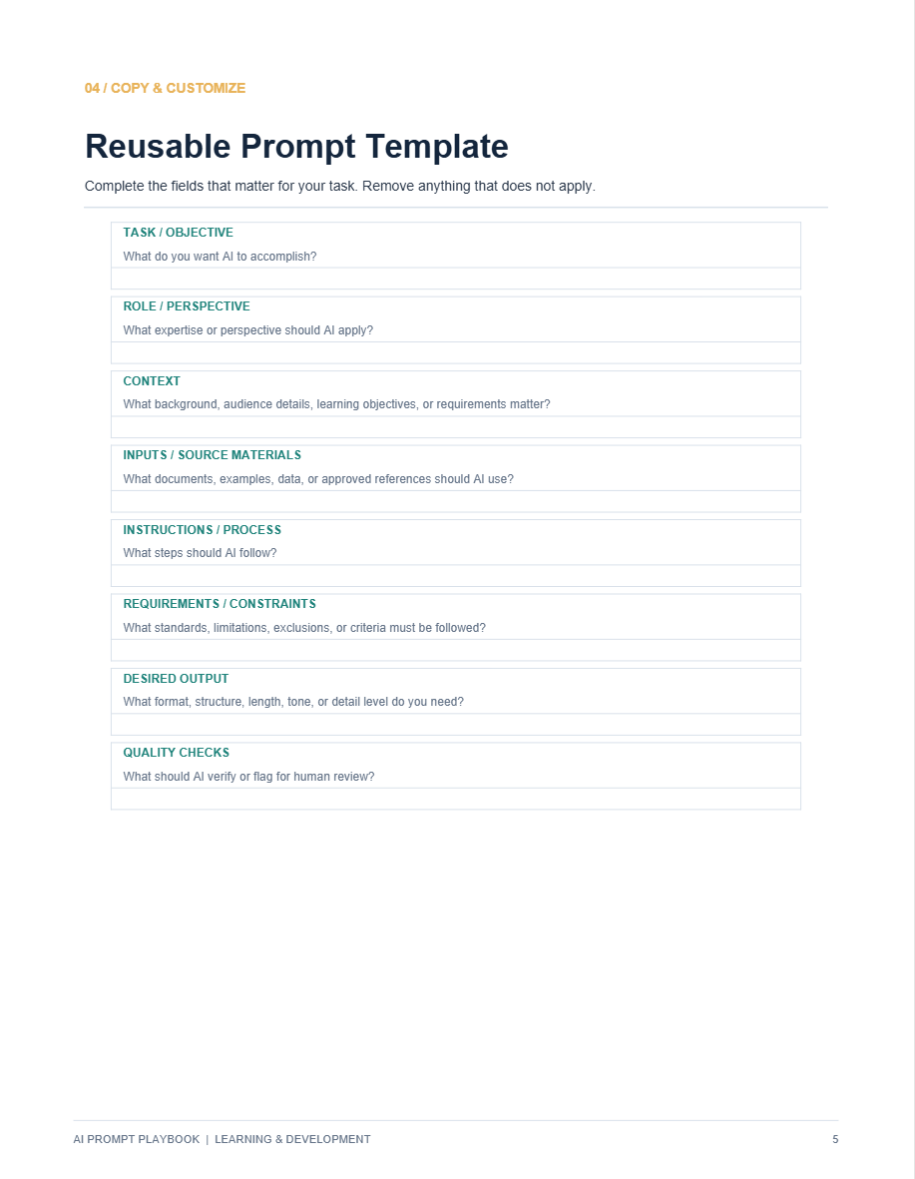
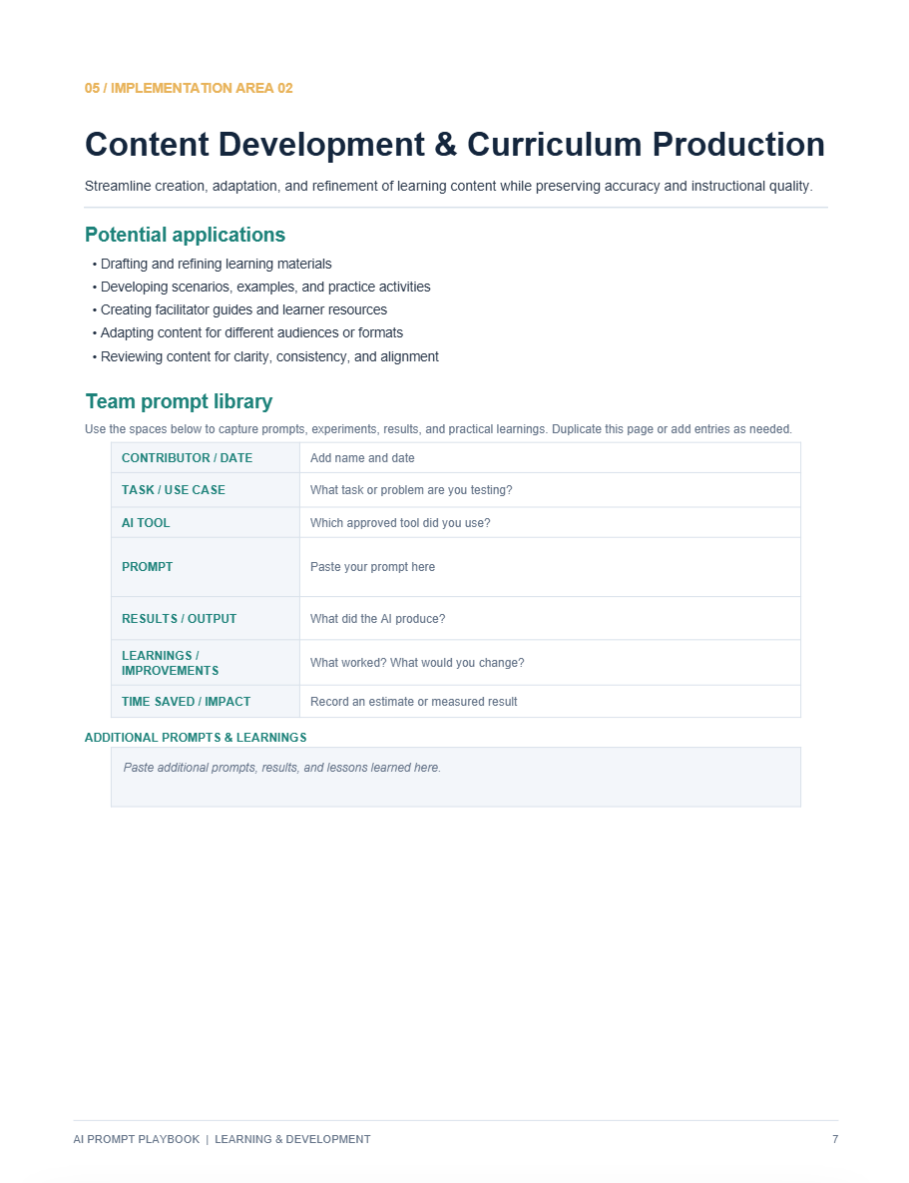
To help the team build practical AI capabilities, I created a collaborative prompt playbook that team members could contribute to and reuse.
The AI Prompt Playbook made experimentation more repeatable, reduced duplicated effort, and helped the team build collective knowledge as AI adoption progressed.
Features:
Overview & Objectives: Outlines the purpose and goals of AI implementation in L&D.
Instructions for Use: Provides step-by-step guidance for testing, refining, and sharing prompts.
Prompt Best Practices: Highlights strategies for creating effective, reliable AI prompts.
Reusable Prompt Template: Offers a standardized structure for documenting prompts and requirements.
Five AI Implementation Areas: Dedicated sections for needs analysis, content development, SME management, instructional design, and quality assurance.
Prompt & Learning Logs: Spaces to document prompts, experiment results, lessons learned, and time savings.
Shared Learnings & Next Steps: Captures insights, workflow improvements, and opportunities to scale successful AI practices.
Results
Content development was one of the five priority areas identified during our AI adoption workshop. Within this workstream, I partnered with another curriculum developer to integrate AI into our course development process and decide where to cut process bloat.
By incorporating AI into our workflow, we reduced course development timelines from approximately 6–8 months to 3–4 months—a roughly 50% reduction based on the reported ranges.
This initiative demonstrated how a prioritized AI use case could translate into measurable operational improvement while preserving the instructional design expertise and human judgment essential to creating quality learning experiences.
Learnings & Improvements
Developing this strategic roadmap reinforced the importance of treating AI adoption as an ongoing organizational change initiative rather than simply introducing new tools. Successful implementation requires clear governance, measurable outcomes, stakeholder accountability, and continuous evaluation.
Improvements I Would Make to the Strategic Roadmap
Strengthen Responsible AI Governance: Establish a more detailed risk assessment process for each use case, including data privacy, information security, output accuracy, intellectual property, and human oversight. I would also incorporate regular risk reviews and clear escalation procedures as AI tools and organizational needs evolve.
Refine Evidence-Based Decision Gates: Define specific, measurable thresholds for advancing each phase, informed by actual baseline data and pilot results. I would establish clearer criteria for when to scale, revise, pause, or discontinue an initiative, ensuring decisions are based on demonstrated business value, output quality, employee adoption, and acceptable risk.